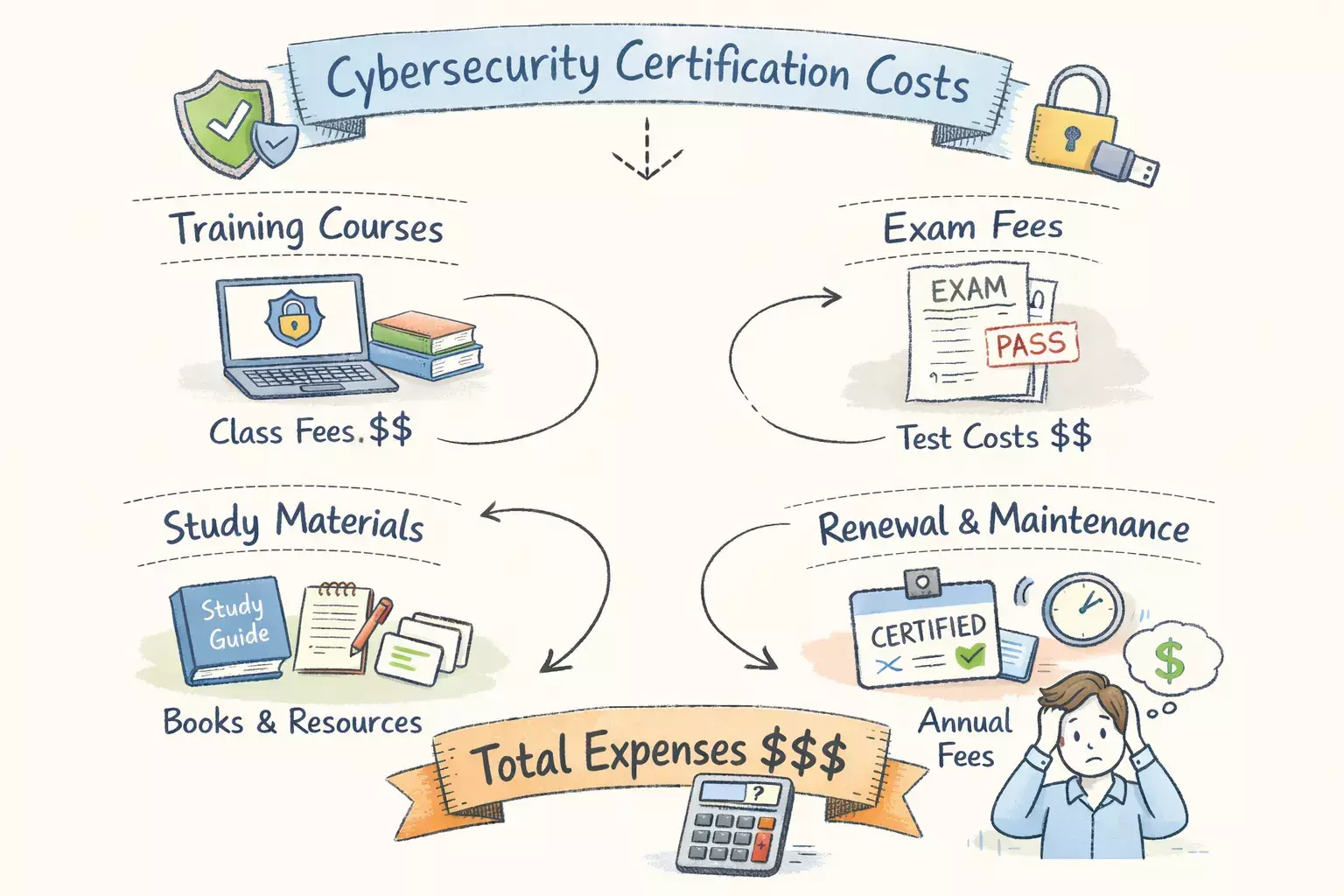
What are the typical costs associated with obtaining a cybersecurity certification? This guide breaks down the main expenses so you can plan your budget: exam fees, study materials, training and bootcamps, retake charges, and ongoing recertification for credentials like CompTIA Security+, CISSP, CEH, OSCP, CISM and GIAC. It also lists benchmarks such as the CompTIA Security+ exam fee and typical ranges for exam bundles, and notes how vendor pricing can vary. Finally, you’ll see a practical price comparison and how ExamVoucherStore’s discounted vouchers and flexible payment plans can lower your overall cost.
You’ll find three budget pathways: low, typical and premium, with concrete totals so you can pick the route that fits your timeline and finances. After reading, you should be able to list expected line items, apply cost-reduction tactics and take one immediate step: choose a pathway, apply a voucher and schedule the exam. The goal is to reduce sticker shock and get you to exam day prepared and within budget.
Key takeaways
If you’re short on time, these are the main cost buckets to remember. They cover exam fees, prep, recurring maintenance and practical ways to lower your outlay.
- Cost baseline: Exam fees vary by credential and level. Expect roughly $300 to $2,500 depending on certification and level, with the CompTIA Security+ fee commonly quoted around $425 when bought from CompTIA.
- Prep budget: Plan for study guides, question banks and lab access. Typical prep ranges from about $50 for basic self-study to $8,000 or more for intensive instructor-led bootcamps and extended labs.
- Recurring costs: Many certifications add recertification fees, membership dues and CPE tracking requirements. Factor annual or multi-year maintenance into long-term planning.
- Three pathways: Low, typical and premium map to self-study, guided training and intensive bootcamps. Each path comes with realistic totals and timelines to help you plan.
- Cost reduction: Use discounted vouchers, employer reimbursement, bundles or flexible payments to lower upfront expense. A simple immediate plan is to buy a voucher, pick one reliable study resource and schedule the exam.
Exam fee snapshot: typical prices for major cybersecurity certifications
Start with a clear baseline when you estimate total cost. For planning, expect entry-level exams to run about $300 to $500, professional exams $600 to $1,200 and specialist or GIAC-level tests $1,200 to $2,500. Always check the issuing vendor for regional pricing and currency differences.
Retakes usually cost about the same as the original exam unless a vendor offers bundled attempts or retake insurance. A $425 base fee plus a full-priced retake doubles that line item to $850, while a bundled option can lower the effective per-attempt cost. Expect checkout add-ons such as online proctoring fees, sales tax or VAT, rescheduling charges and exam center surcharges to add roughly 5 to 15 percent to the sticker price. Confirm all quoted line items and save screenshots before you pay.
Prep cost breakdown: study guides, practice tests and lab subscriptions
Start with essentials for self-study: books, official guides and question banks. A core paperback or eBook typically costs $30 to $80, official vendor guides $50 to $120, and practice test subscriptions range from $25 to $150 depending on length. For entry-level exams, plan for at least one study guide and one practice test; intermediate tracks usually benefit from multiple practice resources to find weak domains and build exam stamina.
- Books and guides: $30 to $120. Official vendor guides sit at the higher end while community-authored books are generally cheaper.
- Practice tests and Qbanks: $25 to $150. Prices vary by question count, explanations and subscription length.
- Video microcourses: $20 to $300. These are optional but help learners who prefer short lectures or demonstrations.
Guided formats vary widely in price. Short online courses and weekend bootcamps typically cost $150 to $600, multi-week instructor-led classes range from $600 to $2,000, and immersive bootcamps can run $2,000 to $8,000 or more. Hands-on labs are essential for performance-based exams such as OSCP and many GIAC certifications; monthly lab subscriptions usually cost $50 to $250 while full course bundles or exercise libraries may be one-time purchases of $300 to $1,200. For vendor-specific lab and exam pricing for OSCP-style programs, check OffSec's pricing information. Plan on 3 to 6 months of lab access for advanced, skill-based certs and consider shorter access windows or vendor bundles to reduce cost.
Overall, a conservative prep budget runs from about $100 to $700 for self-study up to $3,000 to $10,000 for instructor-led and bootcamp-heavy paths, depending on lab duration and coaching. The next section combines exam fees and prep spend into sample totals for common certification scenarios.
Recurring and hidden costs: recertification, CPEs and ancillary fees
Exam fees are only part of the long-term cost. Many certifications require annual maintenance, membership dues or periodic renewals. Expect annual or multi-year fees of about $50 to $500 depending on the credential and any optional membership benefits.
Recertification typically involves either a renewal fee or earning continuing professional education (CPE) credits. You can earn CPEs through free vendor webinars and employer-sponsored training to keep costs low, while paid courses and conferences increase annual expenses. As a conservative estimate, budget $100 to $800 per year for CPEs unless your employer covers most credits.
Hidden line items add up: travel and hotels for in-person testing, special hardware or a home lab, and the opportunity cost of study time. An in-person exam trip can add $200 to $600 for travel and lodging, a modest home lab or peripherals $200 to $1,200, and conference attendance $400 to $2,000. Include a contingency of 10 to 25 percent in your total budget to cover unexpected retakes, last-minute prep or other surprises.
Build your budget: low, typical and premium pathways with sample totals
Pick the pathway that fits your timeline, experience and employer support. The examples below combine exam fees and prep costs so you can see realistic totals and choose the one that matches your situation.
Low-cost pathway: use self-study materials, inexpensive practice tests and a discounted voucher to keep upfront spend low. For example, a Security+ candidate might buy a $50 book, a $40 practice bank and a discounted voucher around $360 from a reseller, for roughly $450 total. For more context on the typical CompTIA Security+ exam cost, vendor pages and independent guides can help you verify current pricing. This covers the exam and targeted practice but provides limited hands-on labs or mentorship.
Typical pathway: combine an instructor-led course, a short lab subscription and a retake allowance for balanced ROI. For Security+, a sample breakdown could be a $600 online course, a $120 official guide, four months of labs at $40 per month ($160), a $425 exam voucher and a $100 retake cushion for about $1,405 total. For a mid-level cert with a $700 exam fee, expect roughly $1,200 for the course, a $150 guide, six months of labs ($240), the $700 voucher and a $150 retake cushion, bringing the total to about $2,440.
Premium pathway: choose a multi-week bootcamp, extended lab access and retake insurance for an accelerated outcome. Typical costs include a bootcamp of $3,500 to $7,000, labs at $500 to $1,200 and retake insurance of $300 to $1,000, so totals commonly range from about $4,300 to $9,200. This route suits candidates with tight deadlines, employer support or a career pivot that requires fast, reliable results.
Quick summary: expect roughly $400 to $700 for the low path, $1,200 to $2,500 for the typical path and $4,000 to $9,000 for the premium path. Choose the pathway that matches your deadline, experience level and employer support.
Ways to lower and offset costs: vouchers, employer programs and scholarships
Discounted exam vouchers, bundles and flexible payment plans cut upfront spend and lower the effective cost per attempt. For example, a single Security+ voucher from the vendor costs $425, while a two-attempt bundle sold by resellers may run about $474 and includes an immediate retake. Use bundles to reduce risk, and track voucher expiration dates in your account so purchases don’t lapse.
Employer reimbursement is another major lever. Request preapproval with a short business case that explains the benefit, attach the voucher invoice and provide the exam blueprint and study timeline; submit receipts and proof of passing as your employer requires. Keep organized records for tax purposes and obtain written pre-approval to prevent reimbursement delays.
Look for scholarships, vendor grants and combined discounts to stretch funds further. Many programs offer student or military discounts, training credits or vendor scholarships—programs such as the AWS Cloud Institute learner grant can offset part of the training cost but require an application, proof of eligibility and a short goals statement. Apply early and combine any award with a discounted voucher to maximize coverage. Time purchases around vendor sales and schedule your exam only after you hit practice milestones such as consistent mock scores to avoid unnecessary retakes.
Final cost takeaway and next steps
To answer the central question—what are the typical costs associated with obtaining a cybersecurity certification—plan for both the exam fee and meaningful prep expenses. Exam prices vary by vendor and level, with entry-level certifications often in the low hundreds and advanced credentials costing substantially more; for authoritative pricing on credentials like CISSP, consult the official ISC2 exam pricing. Prep costs add up through study guides, practice tests, lab subscriptions and optional instructor-led training, so budget for at least one reliable prep resource and hands-on lab time when relevant.
Practical next steps to reduce cost and friction are simple: compare verified voucher prices and instant-delivery options at ExamVoucherStore, pick a targeted study guide that matches the exam blueprint, and add a short lab subscription for performance-based items. Start today by creating an ExamVoucherStore account, adding the voucher you need to your cart, and selecting a study guide or a 30-day lab plan. Those actions will move you toward exam day while keeping costs predictable.